The age of cognitive surrender
Introduction#
First of all, I am not going to write about what cognitive surrender is: there are fantastic materials out there, like this paper from the University of Pennsylvania. In short, cognitive surrender is the idea that humans lazily delegate their reasoning to an external entity that can do it for them, like modern LLMs.
Here I just want to show a couple of scenarios where your choices can make AI either harmful or useful, whether that’s for the software development industry specifically, or for our society in general. I hope you enjoy it!
Difficult knowledge: The academic mercenary vs the clumsy teacher#
The academic mercenary is that colleague you have at high school or uni who would complete an assignment for some money. Many young humans find this shortcut the best way to balance pleasure and academic success, without knowing the underlying debt they are acquiring: cognitive surrender.
In contrast, the clumsy teacher is that friendly professor who seems to have a never-ending pool of wisdom, but whose lessons are so hard to digest that you need to ask them many questions along the way to build your internal map of meaning. Playing the curious student, with the AI model as the clumsy teacher, is the best way to avoid the cognitive surrender debt. Sure, it takes a bit more time and effort, and our brains do not like it, but it eventually pays off.
In the software industry, one can easily map the academic mercenary role to vibe coding, that is, paying an AI in tokens to do the assignment for you. The clumsy teacher, with me being the curious student, is the role I’m practicing a lot lately, and whilst the immediate benefits are less obvious, due to the extra initial investment, I have a growing feeling that this is still a net improvement.
Easy knowledge: The best travel companion#
There are certain types of knowledge that are more straightforward, and I think it’s worth making that distinction explicit here. What if just trusting the AI output is as good as opening a history book by its index and going to the page you are interested in, right on the summary section?
I realized this during my honeymoon, a two-and-a-half-month trip over Southeast Asia. To satisfy my curiosity, I was constantly asking the AI about any culture-shocking fact, historical event or geographic aspect of the place I was visiting. I found this experience super enriching and a net improvement over traditional tour guides, who follow a fixed script, aren’t available 24/7, cost more, and aren’t tailored to what you are actually interested in. For these types of questions, AI hardly ever hallucinates. This type of knowledge is often non-ambiguous, not prone to change, and easy to understand immediately.
Asking things like “Tell me about the influence of the Great Wall of China as a defensive structure against Genghis Khan campaigns” was an absolute joy to me. Another time, whilst in Vietnam at 38 degrees Celsius and 90% humidity, I was also prompted to ask about “the physics of boiling vs evaporation”. It was not cognitive surrender, but a pleasant bridge to on-demand knowledge.

Conclusion#
I find cognitive surrender particularly interesting, because AI is one of those things we create that can easily go against our core human biology. Our brains are lazy and always try to succeed following the path of least resistance, and this is an evolutionary trait that allows us to make fast and sound decisions. Imagine facing a leopard and asking it to give you a day or two to figure out the best course of action via design doc.
In fact, everything we have covered can be compressed into two simple questions: how difficult is the knowledge you are after, and how much of the thinking are you delegating? Handing over the difficult stuff is the academic mercenary shortcut, while working through it with the AI as your clumsy teacher is where real learning happens. Delegating the easy, factual questions is the harmless travel companion, and the remaining combination is just the old, slower way of satisfying our curiosity. The quadrant to watch is the surrender one, because it’s exactly where our lazy brains will drift by default.
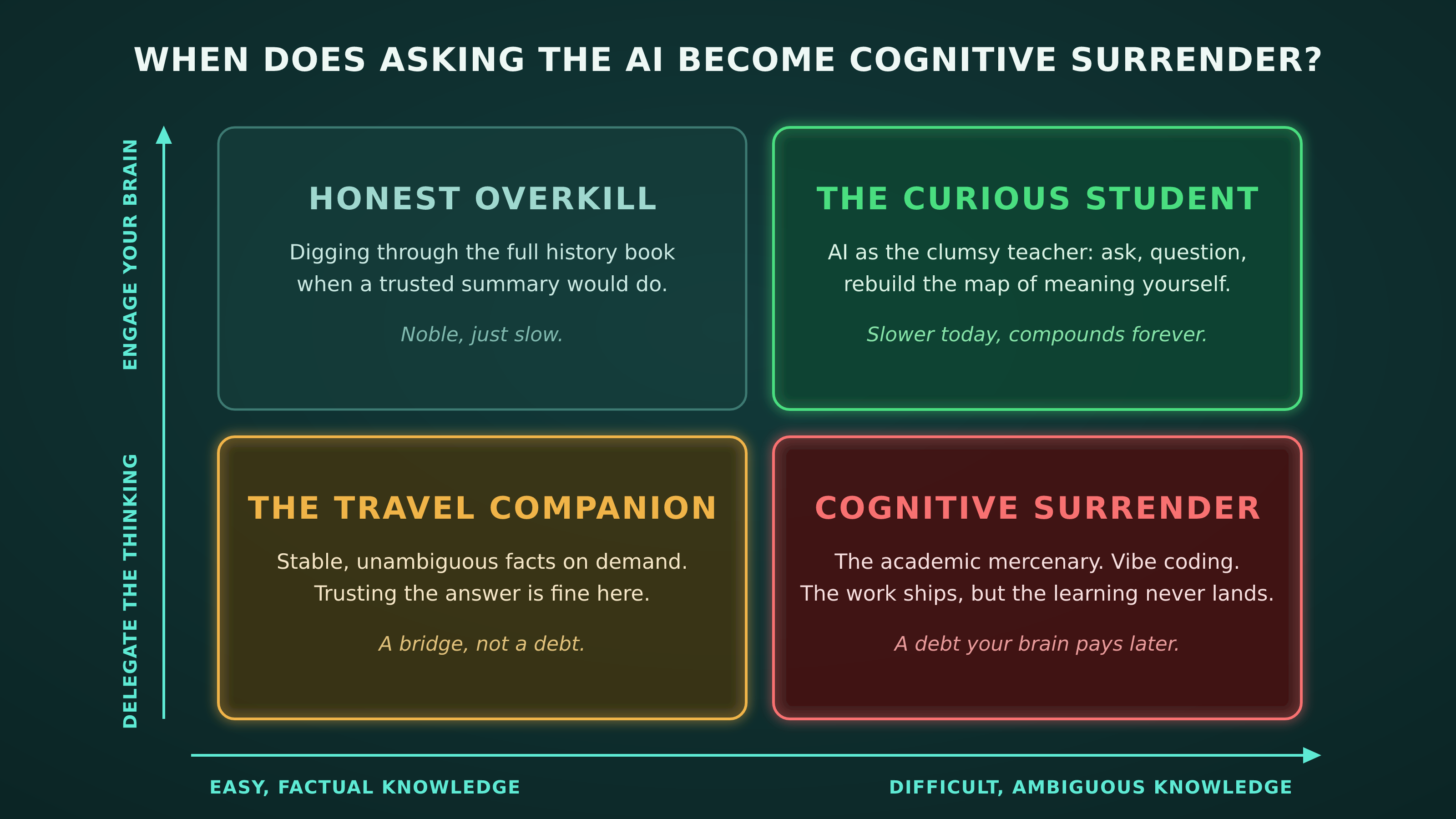
Coming to these concrete realizations is often counter-intuitive, and only by analyzing the bad consequences of the lazy path can we roll back and figure out we were not taking care of our learning process. For the fast-paced software development industry, it’s something we might be able to correct in time. For developing children/teenagers, this is a much bigger risk we need to keep an eye on.
Hopefully these examples are either things you relate to or something you will watch for in the upcoming episodes of your life.
Thanks for reading!