The dystopian promise of cryptocurrencies
Introduction#
I would like to present a series of counterarguments to the mainstream crypto hype, let’s be clear from the start. If you are a believer and have a strong emotional attachment to your investments, this text is probably not for you.
And in the same spirit of honesty, I have no stake in this. I invested a small amount in 2017, rode up some gains, built a couple of cryptomining rigs out of 12 AMD RX 570s and RX 580s when I was at the peak of my hype, froze during the first bubble bust at the end of that year, messed up my Ethereum wallet password, and eventually sold my rigs to end up with a slight loss. My social circle stayed invested in it all along, and I have respectfully stepped aside ever since. This means I have missed a 3x return over those last 9 years ($20K to $60K), which, interestingly, is not that far off what the S&P 500 has done over the same period.


Each of the follow-up sections will challenge the common bullish narrative, and some of them will come from a non-economic perspective, which is less common to see. If you are interested in a new take, whether you are invested or not, you might find this worth reading.
Bitcoin has little use for humanity#
This is a common idea that has floated around from the start, and I feel it still holds true. Bitcoin does not even work as a currency, due to the scaling and volatility problems. El Salvador tried this in 2021, and it doesn’t seem like it’s having the expected impact, since they had to roll back their bet multiple times with law amendments, now leaving Bitcoin as an optional niche for a small group of the population and curious tourists.
What’s left is a store of value. But let’s be honest, literally anything can be a store of value; it’s the default use of every single thing on Earth. You just need someone willing to pay for it, e.g. trading card games, collectible watches, classic cars… At least those things are linked to a hobby.
Decentralization goes against human biology#
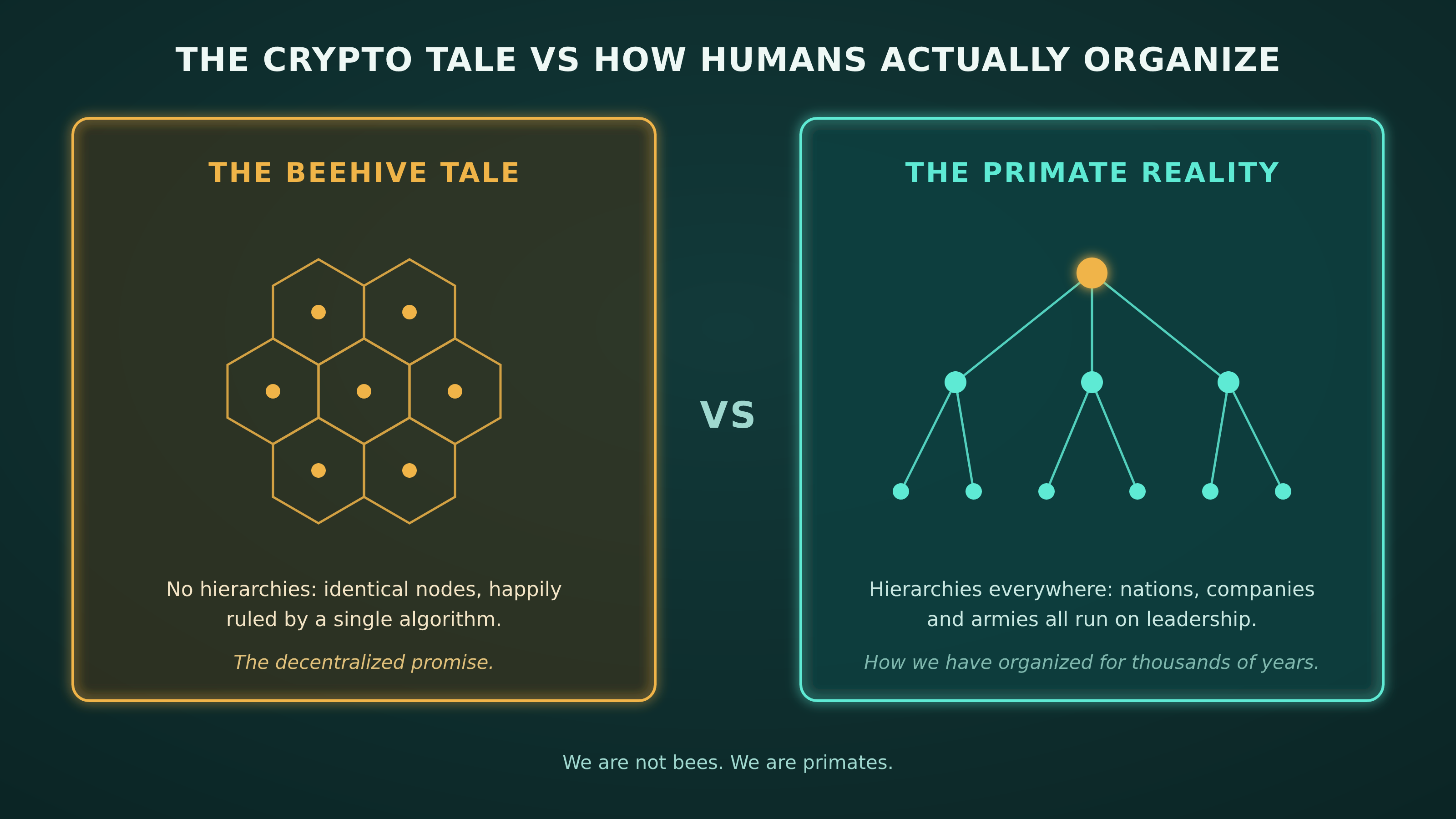
This is, to me, the strongest conviction on the list. The utopian vision of cryptocurrencies is that they provide a fully decentralized economic system, that no government or private bank can mess with. However, I think that is built on top of a hugely misleading assumption: Humans, like many other mammals, do not operate like beehives, they build hierarchies that guide their societies, with better or worse outcomes. The crypto tale says there are no hierarchies, that a single algorithm rules us all, and we are all equal and happily accepting it, that we are nothing but a beehive.
There are multiple empirical examples of this being so wrong, so I will start with a spicy one: Communism tried to test the beehive model, and history has shown how badly it failed, in a pretty embarrassing and cruel way. You can still argue in favour of it, but what you can’t argue against is the list of prosperous nations and how that correlates to the communist model vs the open market model.
Secondly, if you look at corporations all over the world, it’s no surprise that virtually all of them work on top of hierarchical structures, not flat ones. As opposed to governments, which can fail and be corrupted to the deepest roots without necessarily feeling the consequences (the reason why we created democracies as a control mechanism), companies simply disappear the moment they start stringing together a few bad decisions. They don’t have the responsibility of an entire nation on their shoulders, which means they can go for the most efficient type of leadership, the one built around hierarchies.
Lastly, you can look at the military, a place where leadership is even more important. Guess what, flat structures do not work there either. Thinking of democratic votes to decide the path of a squadron or the next aerial attack move just makes me laugh, at the very least.
Now let me bring this down from nations and armies to a single person. Imagine someone who kept their lifetime savings in a crypto wallet and lost the password. That’s it, game over, the money is gone forever, and there is nobody to turn to, because that is the whole point of the design: there is no hierarchy. In our current, imperfect system, you always have a hierarchy path to rely on: your parents, the police, the government, judges, even the army. One of them will stand up to fight the unfair, the nonsense. Forget your bank password and nothing happens; you walk into a branch, prove who you are, and someone with authority puts things right. In the crypto world, the same algorithm that supposedly liberates you is the one that shrugs at your tragedy.
All in all, whether we like it or not, we are not bees, we are primates, and our society structures have been built like this for thousands of years. Our biology might change in the future, but evolution tells us that will take thousands, if not millions of years to happen. If we make it that far, I am hoping our economic and political systems will have been fixed by then anyway.
You can’t even achieve decentralization with the current socioeconomics#
Just to elaborate a bit more on decentralization, the one that the crypto world is currently delivering with proof of work is really lacking. The ability to access the technology to mine at a low cost, and access to cheap energy, already rule out a lot of people in an uneven way. I toyed with the idea of running some Bitcoin miners back in 2017, and I realized acquiring the good ones was out of my league due to supply chain, customs and whatnot. Not to mention running them in countries like China would cost a fraction in energy. That’s how I ended up building my own Ethereum miners on top of generic gaming hardware, even though that didn’t solve the energy problem.
How strong is the first-mover moat?#
Something I rarely see argued out there is the real moat Bitcoin has: being the first one to arrive. Don’t get me wrong, that’s still a moat. However, one needs to look at what prevents that advantage from being taken over by other, similar approaches, and that’s where I think it starts to tumble down a bit.
People trust the dollar because the United States stands behind it: the world’s largest economy, backed by the most bleeding-edge technology companies and a huge army. That is a real moat, even if the monetary policies are sometimes doubtful.
What stops a different new, improved crypto algorithm from creating a much better blockchain than Bitcoin? Why would society stay forever loyal to Bitcoin just because it arrived first? To me, that would need a stronger reason to be future-proof, like the ones I provided for the dollar. Sure, the US might eventually be overtaken as the leading economy, and the dollar with it, but that won’t happen until fundamentals are damaged. For Bitcoin, I see no fundamentals beyond being there first.
If all people agreed to accept Bitcoin, why wouldn’t governments be able to reflect that common desire and build a better, non-profit, world-wide crypto protocol for a shared economic system? Didn’t we accidentally agree on something similar in the past with the TCP/IP protocol that gave birth to the internet? Wouldn’t that make Bitcoin like a redundant “black market” of sorts?
Crypto world has a suspiciously strong correlation with high-growth tech companies#
Here is my last argument, also an empirical one I have observed over time. The whole store-of-value story really starts to wobble when you see the correlation of Bitcoin price with speculative investments, like those high-growth, hot tech companies. This tells a different story from the one being told by the believers, which should make people raise an eyebrow here and there. Every time there has been fear in the market, Bitcoin has sold off quickly instead of doing the opposite, which is exactly what the bullish side claims it won’t do.
Conclusion#
This is not financial advice, and as you can see, I didn’t bring much economic analysis to the table. What I really want you to think about after reading this is whether you think Bitcoin is something that truly fits our society, or just a technological dystopia.
Thanks for reading!